Difference Between a Traditional Security Audit & AI Security Audit
Introduction
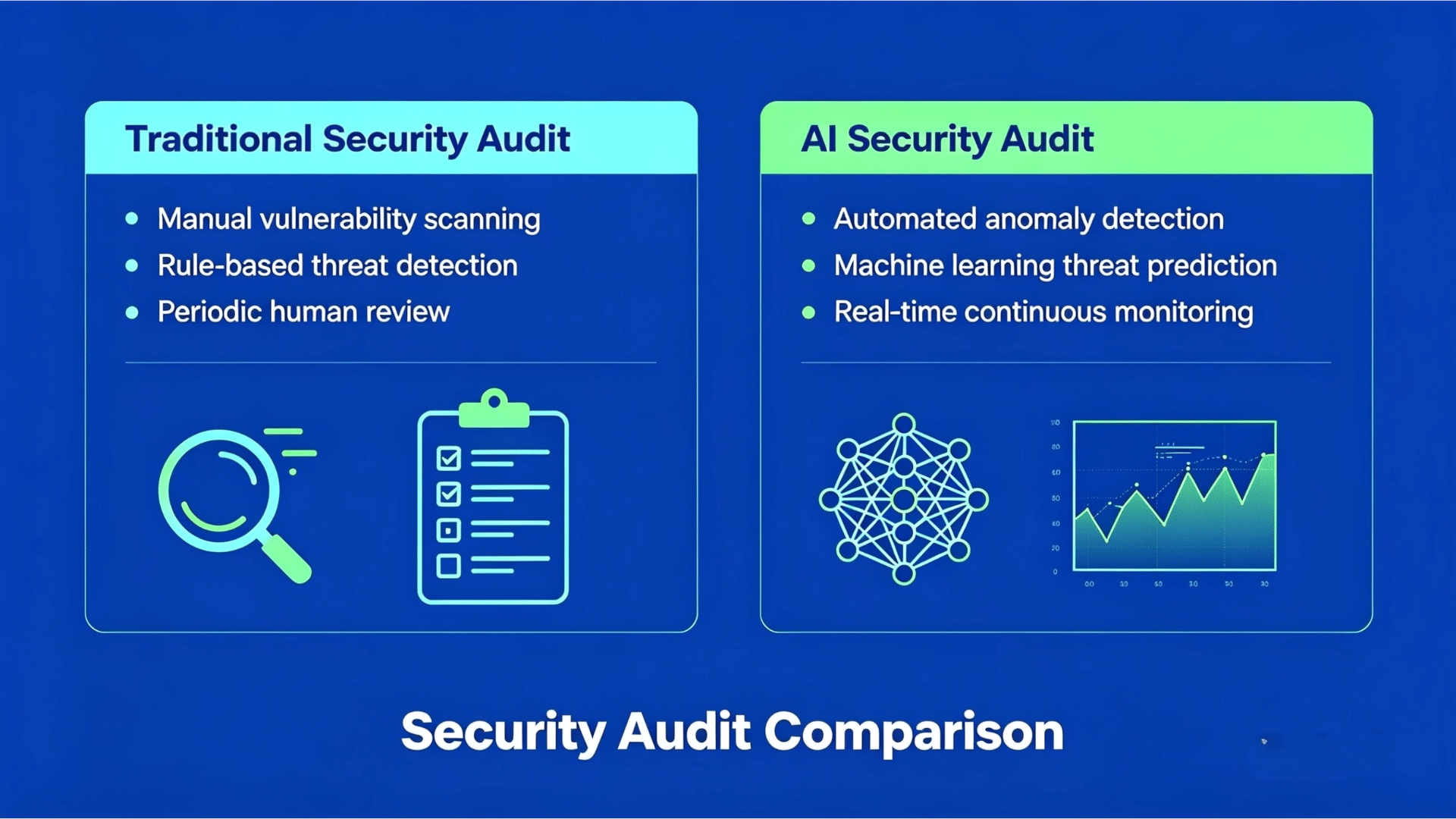
As businesses continue to adopt artificial intelligence, cybersecurity is evolving just as fast. While traditional security audits have long been the standard for protecting IT environments, AI introduces a whole new layer of complexity—and risk.
Understanding the difference between a traditional security audit and an AI security audit is essential for businesses that want to stay protected in 2025 and beyond.
What Is a Traditional Security Audit?
A traditional security audit evaluates an organization’s IT infrastructure to identify vulnerabilities and ensure compliance with security standards.
It typically focuses on:
- Network security (firewalls, routers, endpoints)
- Access control and user permissions
- Data protection and encryption
- Software vulnerabilities and patch management
- Compliance requirements (HIPAA, GDPR, etc.)
Goal: Protect systems from unauthorized access, data breaches, and known cyber threats.
What Is an AI Security Audit?
An AI security audit goes beyond infrastructure—it evaluates the behavior, integrity, and risks of AI systems themselves.
It focuses on:
- AI model integrity and accuracy
- Data quality and bias risks
- Model manipulation (adversarial attacks)
- Data poisoning vulnerabilities
- AI decision transparency and explainability
- Compliance with AI regulations and ethics standards
Goal: Ensure AI systems are secure, reliable, and making safe, trustworthy decisions.
Key Differences Between Traditional & AI Security Audits
- Scope of Evaluation
- Traditional Audit: Systems, networks, and infrastructure
- AI Audit: AI models, training data, algorithms, and outputs
AI audits expand security beyond hardware and software into decision-making systems.
- Type of Threats
- Traditional Threats: Malware, phishing, ransomware, unauthorized access
- AI Threats: Data poisoning, adversarial inputs, model inversion, bias exploitation
AI introduces new attack vectors that traditional audits don’t cover.
- Data Considerations
- Traditional Audit: Focus on protecting stored data
- AI Audit: Focus on how data is used, trained, and interpreted
Poor-quality or biased data can lead to dangerous AI decisions, even if systems are technically secure.
- Compliance & Regulations
- Traditional Audit: IT security standards and frameworks
- AI Audit: Emerging AI regulations, ethical guidelines, and governance policies
AI compliance is rapidly evolving, and businesses must stay ahead to avoid legal and reputational risks.
- Ongoing Monitoring
- Traditional Audit: Periodic checks
- AI Audit: Continuous monitoring of model performance and behavior
AI systems change over time, meaning risks can evolve even after deployment.
Why Businesses Need Both
The reality is simple: one cannot replace the other.
A traditional audit protects your infrastructure.
An AI audit protects your intelligence layer.
Without both:
- You may secure your systems but leave AI vulnerable
- Or secure AI while leaving your network exposed
Final Thoughts
AI is transforming how businesses operate—but it’s also reshaping the cybersecurity landscape.
If your business is using AI tools, automation, or machine learning in any capacity, relying solely on traditional security audits is no longer enough.
Take Action with Jackson—Your Cybersecurity Satisfaction!
At Jackson Technologies, we help businesses bridge the gap between traditional cybersecurity and AI risk management.
👉 Schedule your FREE Security Audit today and ensure your business is protected from both known and emerging threats.