Why Manufacturing Businesses Need IT Security Audits More Than Ever
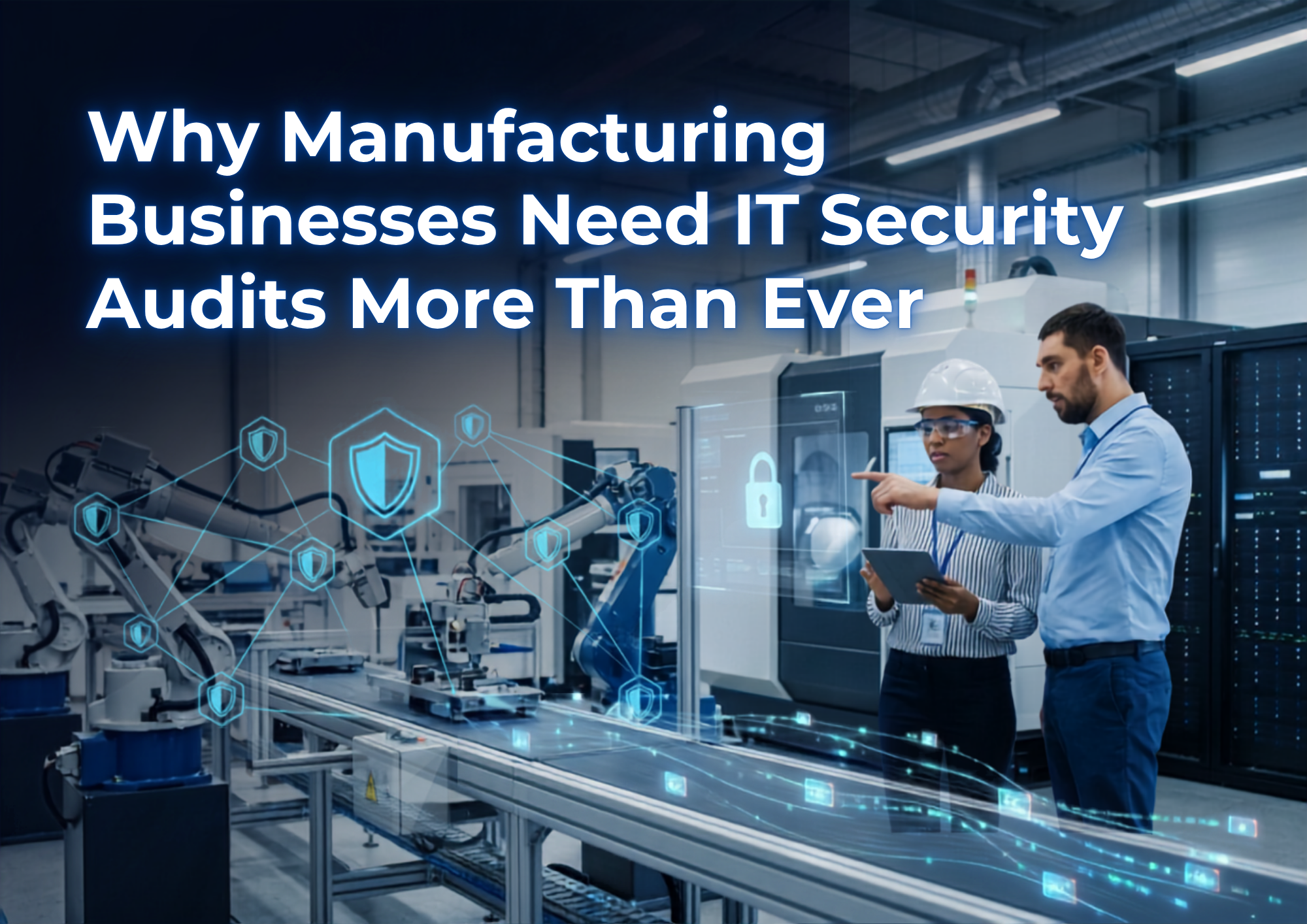
Manufacturing has become more connected than ever. Production equipment, warehouse systems, cloud applications, employee devices, suppliers, and business networks all work together to keep operations moving.
That connectivity creates new opportunities for efficiency—but it also creates new cybersecurity risks.
For manufacturing businesses, a cyberattack is no longer just an IT problem. A compromised system can interrupt production, delay shipments, expose sensitive information, and create significant financial losses. This is why regular IT security audits have become an essential part of protecting modern manufacturing operations.
Manufacturing Is More Digitally Connected
Modern manufacturing facilities rely on technology for nearly every stage of the operation. Common examples include:
- Industrial control systems and connected machinery
- Warehouse management systems
- Inventory and supply chain software
- Cloud applications
- Remote access tools
- Employee computers and mobile devices
- Security and access control systems
- Internet of Things (IoT) devices
Each connected system can potentially become an entry point for attackers. An IT security audit helps identify weaknesses before criminals have the opportunity to exploit them.
Manufacturing Businesses Are Attractive Targets
Cybercriminals understand how disruptive an attack on a manufacturing company can be.
Ransomware, phishing, stolen credentials, vulnerable remote-access systems, and outdated software can all give attackers a path into a business network. Once inside, attackers may attempt to steal data, disrupt operations, or lock critical systems until a ransom is paid.
For a manufacturer, even a short period of downtime can affect production schedules, customer deliveries, employees, and revenue.
Legacy Systems Can Create Hidden Security Risks
Manufacturing facilities often depend on equipment and systems that have been operating for years. Some may not receive regular security updates or may rely on older operating systems.
Replacing production equipment may not always be practical, but that doesn't mean these systems should be ignored.
A security audit can help determine:
- Which systems are outdated
- Which devices are exposed to the network
- Where security patches are missing
- Whether network segmentation is being used
- Who has access to critical systems
- Whether legacy equipment creates unnecessary risk
Understanding these weaknesses allows businesses to develop a realistic plan for reducing exposure without unnecessarily disrupting production.
Third-Party Access Can Increase Risk
Manufacturers frequently work with equipment vendors, contractors, suppliers, logistics providers, and IT service providers. These relationships may require outside parties to access business systems remotely.
If third-party access isn't properly controlled, monitored, and removed when no longer needed, it can become a serious security weakness.
An IT security audit can review vendor access, remote connections, account permissions, and authentication practices to determine whether external access is appropriately protected.
Employees Are Still a Critical Part of Security
Technology alone cannot prevent every cyberattack.
Employees may encounter phishing emails, suspicious attachments, fake login pages, or social engineering attempts. In manufacturing environments, employees may also share workstations or use devices across different areas of a facility.
Security audits can help identify areas where additional employee training, stronger authentication, access controls, or security policies may be necessary.
What Does a Manufacturing IT Security Audit Look At?
A comprehensive audit may examine:
- Network infrastructure and segmentation
- Firewalls and endpoint protection
- User accounts and permissions
- Password and authentication policies
- Remote access
- Software and patch management
- Backup and recovery procedures
- Wireless networks
- IoT and connected devices
- Vendor access
- Security policies
- Incident response procedures
- Employee security awareness
The goal isn't simply to find problems. It's to understand the organization's current security posture and prioritize improvements based on actual business risk.
Don't Wait for an Incident to Find Your Weaknesses
One of the biggest cybersecurity mistakes a manufacturing company can make is assuming that everything is secure because nothing has gone wrong yet.
A security audit provides an opportunity to identify weaknesses before they become costly incidents.
For manufacturing businesses, cybersecurity should be treated as part of business continuity—not just an IT responsibility.
Protect Your Manufacturing Business with Jackson Technologies
At Jackson Technologies, we help businesses identify cybersecurity weaknesses and take practical steps toward improving their IT security.
A professional IT security audit can help you understand where your business is vulnerable, what needs immediate attention, and what improvements should come next.
Don't wait for a cyberattack to reveal your security gaps.
Contact Jackson Technologies today to learn how a FREE IT Security Audit can help protect your business, systems, and operations.